

Console > Repositories to list, connect, configure, pause, validate, and remove repositories.
Track review status, decisions, and findings in the Ops dashboard. Use Console > Audit Trail only for technical event details, diagnostics, and administrative audit.
Who can access
Repositories require a Workspace admin. Platform admins also have access. Roles are fixed capability sets defined by Acrity, not configurable by your organization.Connect repositories
1
Open connection
Go to
Console > Repositories > Connect repository.2
Choose source
Select connected app, manual credential, or local connector.
3
Select repositories
Choose available repositories or enter names according to the selected source.
4
Configure PM
Optionally associate a task management provider and extraction fields.
5
Review rules
Configure branches, draft behavior, checks, and language when needed.
6
Save
Save and track readiness status in the list or repository detail page.
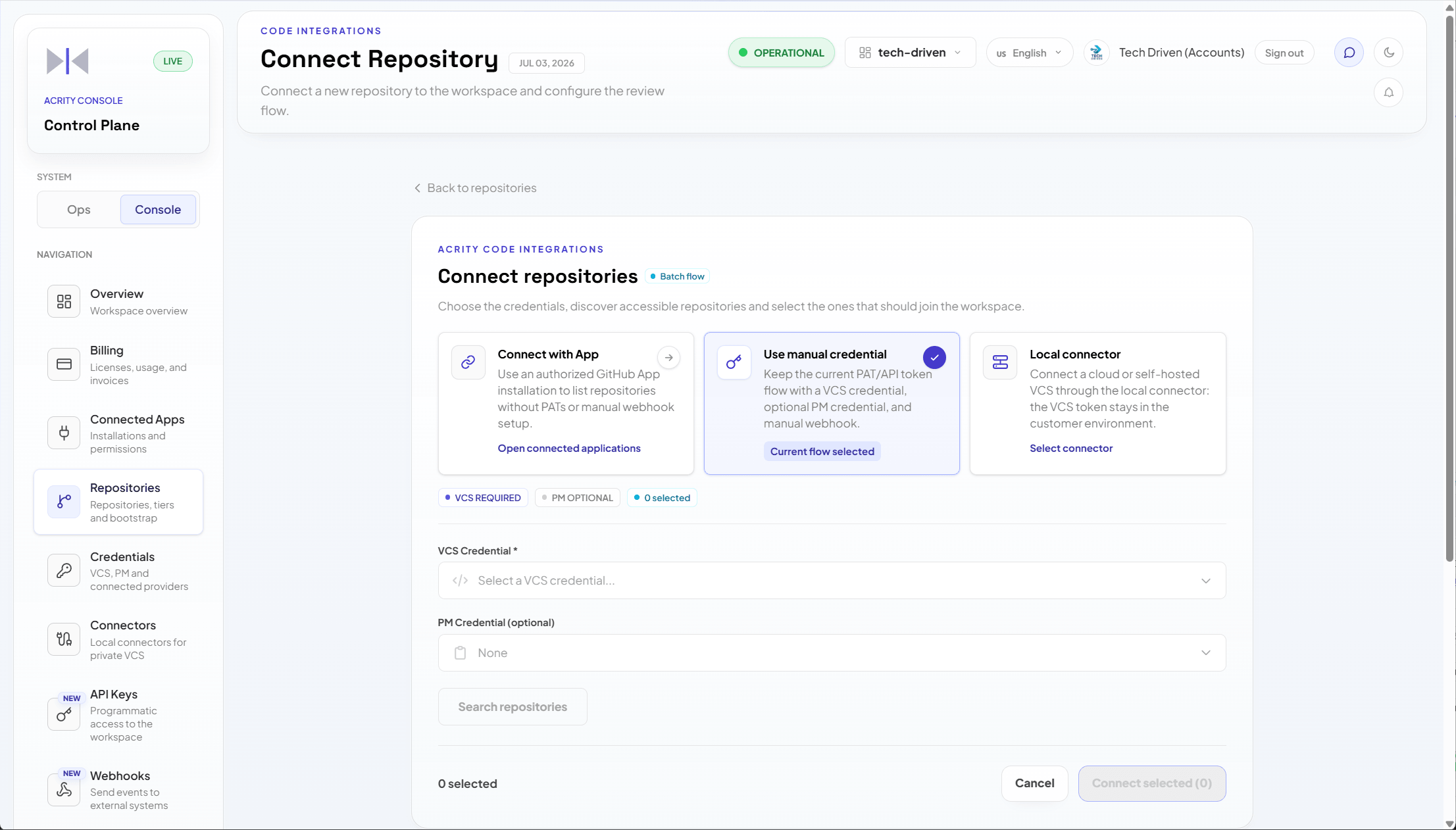
Connection methods
Readiness states
A repository must reach Ready before Acrity analyzes its pull requests or merge requests. Track the current state in the repository list and on the repository detail page. BootstrappingARCHITECTURE.md is required, not optional. Until it is merged, the repository stays in Awaiting architecture merge and does not receive reviews.
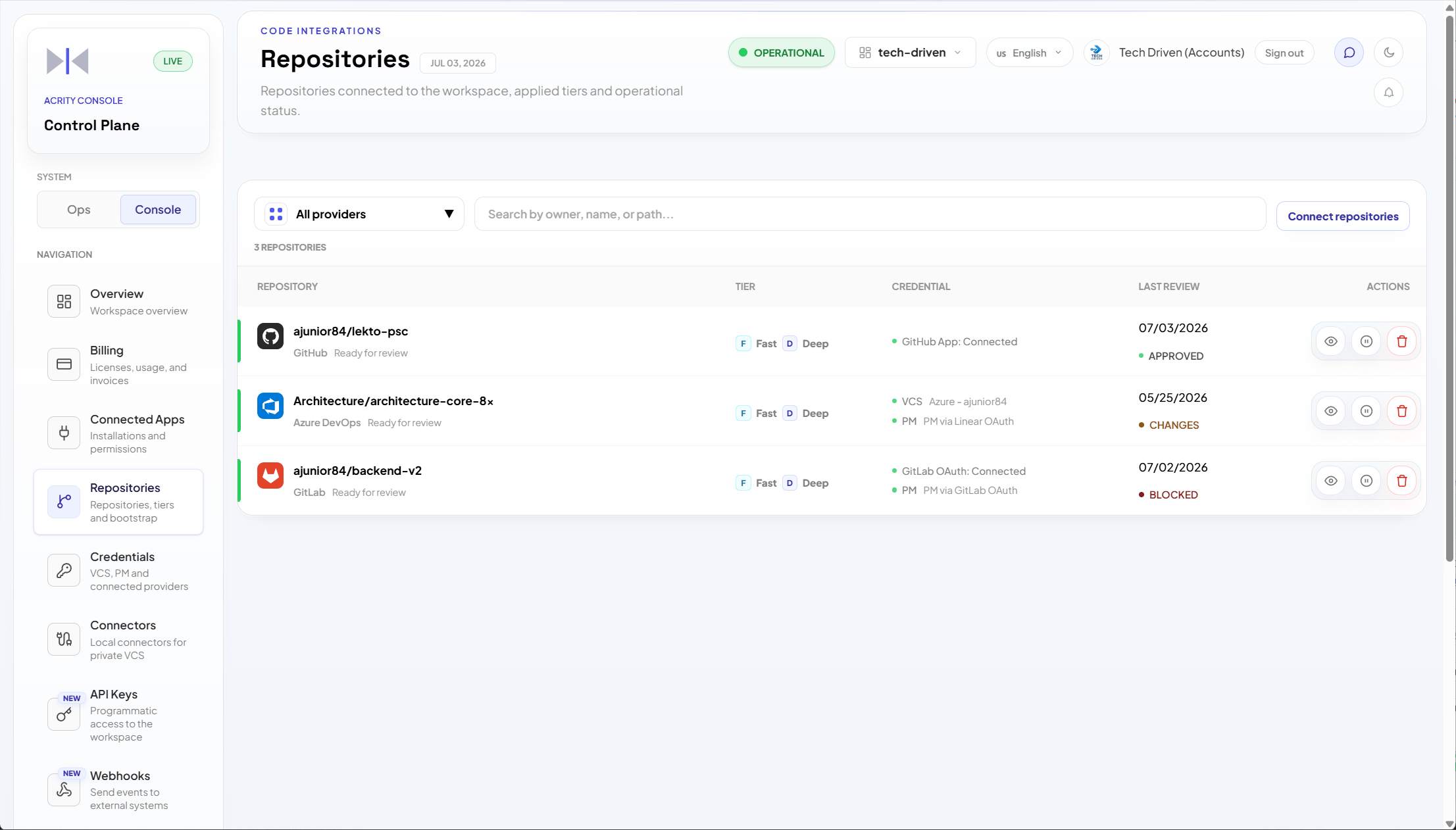
List screen
The repository list helps identify:- connected repositories;
- readiness state;
- VCS provider;
- authentication method;
- latest validation;
- webhook, credential, or connector alerts;
- repositories that require action before receiving reviews.
Repository detail
The detail page concentrates project settings.Repository language
The repository language overrides the workspace default for that project. Use it when:- a team works in a different language than the rest of the workspace;
- customer repositories require localized responses;
- review comments need to follow a specific communication standard.
Branch rules
Branch rules help avoid reviews in scenarios that do not need analysis or generate noise. Common settings:- root or main branches, such as
main,master,develop, or equivalents; - ignore merges between root branches;
- rules to ignore specific source and target combinations;
- matching by exact text, prefix, suffix, substring, or configured pattern;
- review of draft PR/MR;
- behavior when provider checks indicate success.
PM integration
PM integration lets Acrity relate PRs/MRs to tasks, acceptance criteria, and product context. Common fields:- task identifier;
- acceptance criteria;
- story points;
- sprint;
- epic;
- priority;
- component;
- labels;
- fallback field when the primary information is unavailable.
- branch name;
- PR/MR title;
- PR/MR description;
- comments when enabled by configuration.
Repository-level review settings
Repository settings should be used for exceptions to the workspace default. Use them when:- a project requires different instructions;
- a repository needs only one review tier;
- the team has specific conventions;
- review output should use different language or focus.
Console > Policy Engine.
Pause and resume reviews
Pausing reviews prevents new automated analyses for the repository while the pause is active. Use pause when:- the repository is being migrated;
- the provider is unstable;
- credentials are being rotated;
- the team wants to stop reviews for a planned window;
- rules need to be reviewed before continuing.
VCS webhook
The VCS webhook allows provider events to trigger Acrity. In the Console, you can:- configure webhook when the provider and connection method allow it;
- revalidate webhook;
- review configuration status;
- identify permission or secret pending items.
Console > Connectors documentation.
How reviews are triggered
Acrity starts a review when your provider sends a pull request or merge request event to Acrity’s inbound VCS webhook. For connected app connections, Acrity registers the webhook for you. For manual credential and local connector connections, you paste the webhook into the provider yourself:1
Copy the inbound webhook
Open the repository detail page and go to the VCS webhook section. Copy the inbound webhook URL and the signing key.
2
Add the webhook in your provider
In your VCS provider settings, create a webhook. Paste the URL into the payload or target URL field and the key into the secret field.
3
Select events
Subscribe to pull request or merge request events so the provider notifies Acrity when a PR/MR is opened or updated.
4
Revalidate
Return to the VCS webhook section and revalidate. Acrity confirms it can receive events before the repository becomes Ready.
Architecture bootstrap
The Bootstrap tab helps prepare architecture documentation for the repository when the flow is available. Use it to:- check whether the repository already has architecture documentation;
- start assisted generation;
- review proposed material;
- choose target branch when applicable;
- complete the flow with or without commit, according to displayed options;
- repeat or restart when the screen indicates it is allowed.
Security scans
When enabled, the repository can show security and dependency scan information. Use the screen to track the latest scan, next execution, and available actions. Data and security details are inSecurity > Data handling.