

Console > Webhooks to create, test, activate, deactivate, edit, and track deliveries.
When to use
Use webhooks when:- an external system needs to react to Acrity events;
- an internal automation should receive notifications;
- you need to feed observability, audit, or dashboards;
- integrations through API polling are not desirable.
Console > API Keys when the external system needs to actively query data.
Who can access
Managing webhooks requires a Workspace admin (platform admins also have access). Roles are fixed capability sets defined by Acrity, not configurable per workspace.Main fields
Create a webhook
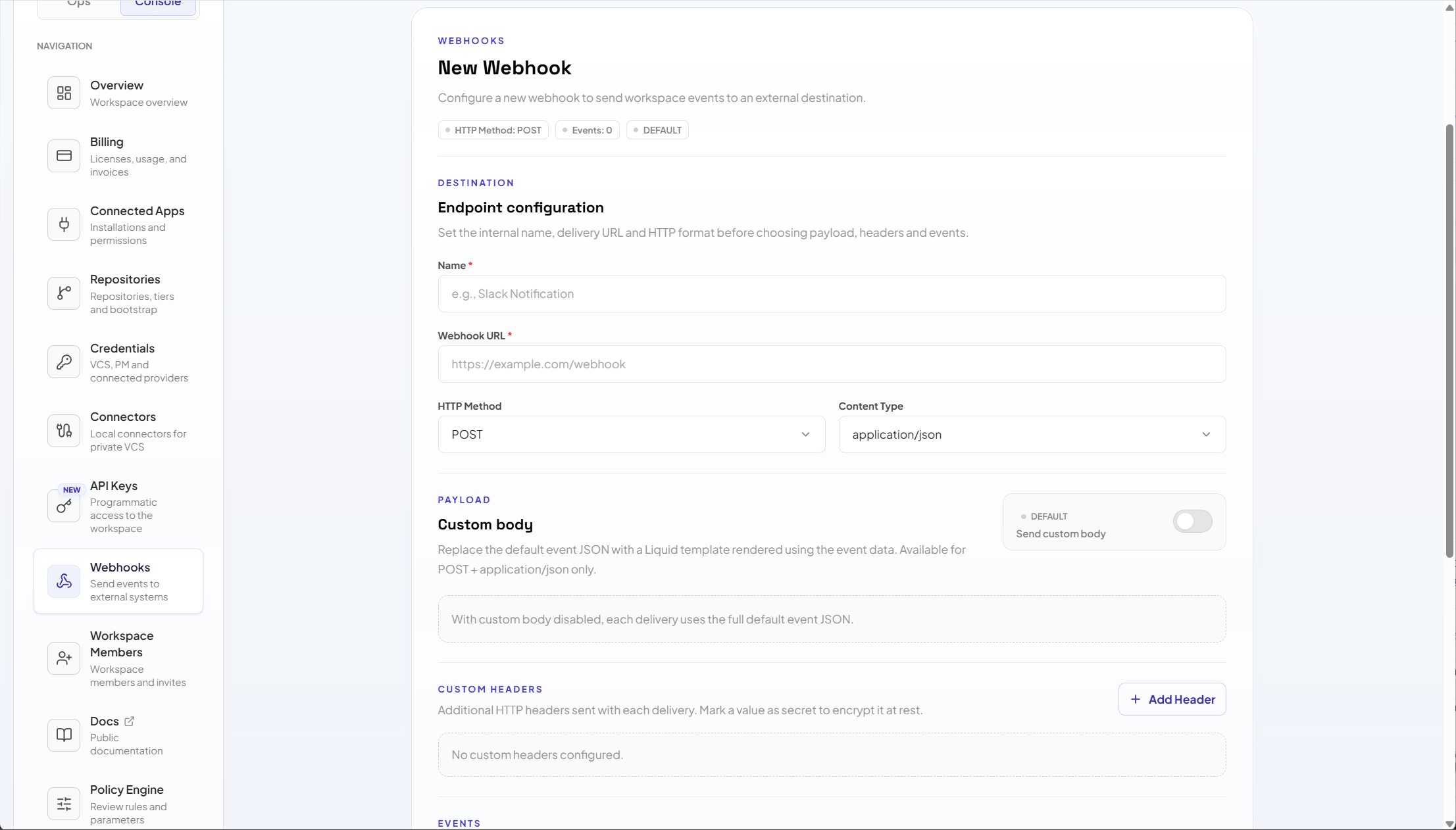
1
Open webhooks
Go to
Console > Webhooks.2
Create new
Choose
New webhook.3
Enter destination
Fill in name, URL, method, and content type.
4
Select events
Choose the events that should trigger the webhook.
5
Configure security
Add required headers and enable HMAC when the recipient can validate signatures.
6
Test
Use the Test event action to send a sample delivery and preview the request before enabling in production.
7
Save
Save and monitor the first deliveries.
Headers and secrets
Use headers to send tokens, identifiers, or information required by the destination. Best practices:- mark any header that contains a token or secret as secret;
- do not put secrets in the webhook name;
- prefer token rotation in the destination system;
- remove headers that are not used;
- document the endpoint owner internally.
HMAC
HMAC allows the destination system to validate that the payload came from Acrity and was not changed in transit. Use HMAC whenever the destination supports signature verification. When enabling:- Generate or enter a strong secret.
- Configure the same secret in the destination system.
- Test a delivery.
- Reject payloads without a valid signature at the destination.
Body template
The body template customizes the body sent. Use it when the destination expects a specific format. Recommendations:- start with a simple payload;
- validate with preview before saving;
- avoid including unnecessary sensitive data;
- maintain compatibility with the destination system;
- version important changes on the receiver side.
Test delivery
Before activating a critical webhook:- use the Test event action;
- confirm destination response status;
- check receiver system logs;
- validate HMAC signature when enabled;
- review headers and content type;
- confirm that the expected payload arrived.
Delivery history
The webhook detail page can display delivery history. Use this history to investigate:- successful or failed sends;
- status returned by the destination;
- response time;
- test or delivery payload when shown by the screen;
- connection, TLS, or validation errors.
Activate and deactivate
Deactivate a webhook when:- the destination is under maintenance;
- the endpoint was replaced;
- secret exposure is suspected;
- the integration is generating noise;
- you need to pause deliveries temporarily.
Common issues
Security
Webhooks can send operational data outside Acrity. Configure only trusted destinations and periodically review which events are active. Details about data handling are inSecurity > Data handling.